S/4HANA migration for machine builders: how to prepare material master and BOM data
Whatever the migration approach, bad master data moves with you unless you clean it first. A 6-step plan for material master, BOMs and Business Partner data, with readiness rules and a score you can track weekly.
Not ready to talk yet? Take the 3-minute Data Foundation Check
TL;DR
- Greenfield, brownfield or selective: bad master data moves with you unless you clean it first.
- Clean before the project, not during it. The project plan has no room for it.
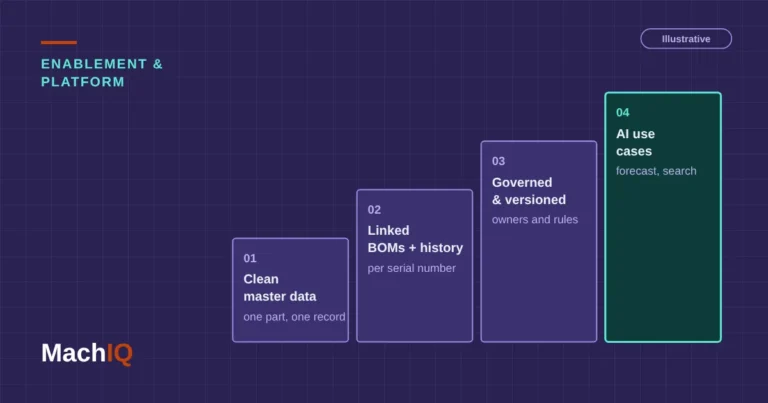
- Focus on what blocks go-live: material master, BOMs, customers and suppliers (Business Partner), classification and supersession.
- Track readiness with written rules and a score per object. Rerun it every week until cutover.
Why does master data decide the S/4HANA timeline?
Mainstream maintenance for SAP ECC 6.0 ends at the end of 2027, with optional extended maintenance until 2030. Many machine builders are in the middle of their move right now. Test loads are where schedules slip, and they mostly fail on data, not on code.
| Approach | What happens to the data | Where data prep focuses |
|---|---|---|
| System conversion (brownfield) | Existing data is converted in place | Cleanse and archive before conversion, prepare Customer-Vendor Integration |
| New implementation (greenfield) | Data is extracted, transformed and loaded fresh | Decide what not to take, map to new structures |
| Selective data transition | Chosen company codes, plants or history are moved | Scope rules per organisational unit |
Which objects matter most for a machine builder?
| Object | Typical problems | Why it hurts in S/4HANA |
|---|---|---|
| Material master | Duplicates, free-text descriptions, inactive materials, mixed units | Every duplicate multiplies BOM, routing and stock records to migrate and test |
| BOMs (STKO / STPO) | Old alternatives, items pointing to blocked materials, missing effectivity | Load errors and wrong MRP explosions after go-live |
| Customers & suppliers → Business Partner | Duplicates across company codes, missing tax data, dead accounts | CVI conversion fails or creates duplicate business partners |
| Classification | Classes and characteristics nobody maintains | Variant configuration and search break |
| Spare parts & supersession | Successor information hidden in text fields | Lost in migration unless it is structured first |
How do you prepare? A 6-step plan
- Profile. Measure duplicates, blanks, invalid values and usage per object. Usage means any movement, order or where-used in the last few years.
- Decide what stays. Materials with no stock, no open documents, no movements for 5+ years and no where-used are archive candidates. Get sign-off from engineering and service, not only IT.
- Merge duplicates. Pick a survivor, map the others to it, update BOMs and open documents. Keep the mapping table. You will need it to read history.
- Standardise. Units, descriptions in noun-modifier form (BEARING, BALL, 6204-2RS), material types, and classification to eCl@ss or ETIM where it helps.
- Fix BOMs. Remove items pointing to blocked materials, clean up obsolete alternatives, structure supersession.
- Score and repeat. Written rules per object, a readiness score, rerun weekly until cutover.
What readiness rules look like
RULE MAT-01  description filled, max. 40 characters
RULE MAT-04  base unit in approved list (PC, KG, M, L, SET)
RULE MAT-09  no other material with same normalised description + manufacturer part no.
RULE BOM-03  no BOM item pointing to a material with deletion flag
RULE BP-02   VAT ID present for EU customers

Readiness (per object) = records passing all rules ÷ records in scope
Don’t archive your installed base
A spare part with no movement for six years may still be the only part that fits 300 machines in the field. Check the service BOM and installed base before you archive anything.
Who should own what?
| Task | Owner |
|---|---|
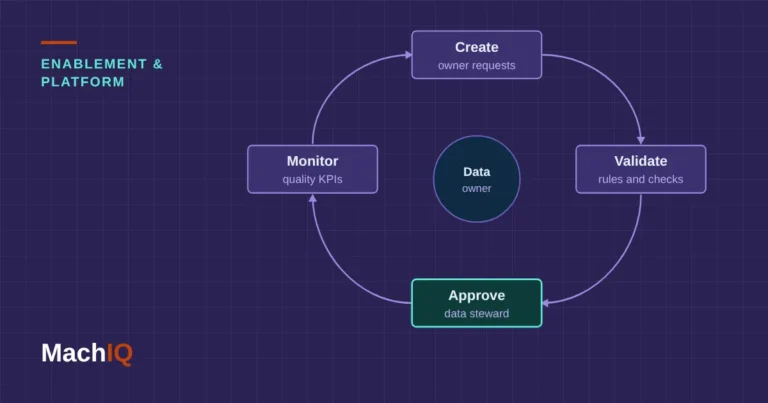
| Rules and readiness score | Master data team |
| What to archive | Engineering, service and finance together |
| Merging duplicates | Master data team, approved by engineering |
| BOM clean-up | Engineering and manufacturing engineering |
| Load and test | System integrator / migration team |
Checklist: are you ready to start?
- Every object in scope has a named owner
- Data-quality rules are written down, not only in people’s heads
- A baseline readiness score per object exists
- Archive criteria are signed off by engineering and service
- A duplicate mapping table is kept for history
FAQ
When does SAP ECC mainstream maintenance end?
Mainstream maintenance for SAP ECC 6.0 ends at the end of 2027. SAP offers optional extended maintenance until the end of 2030 at an additional cost.
Should we clean data before or during the S/4HANA project?
Before, as far as possible. Cleansing during the project competes with design, testing and training for the same people, and test loads keep failing on the same errors.
What is the Business Partner in S/4HANA?
In S/4HANA, customers and suppliers are maintained as Business Partners. In a system conversion, existing customer and vendor masters are converted with Customer-Vendor Integration (CVI), which stops on inconsistent data.
Which materials can we archive before migration?
Typical candidates have no stock, no open documents, no movements for several years and no where-used. Keep anything that is still a spare part for machines in the field.
Does the material number length change in S/4HANA?
Yes. S/4HANA supports material numbers with up to 40 characters instead of 18. It is a chance to rethink numbering, but many companies keep their existing numbers to avoid touching drawings, labels and catalogues.
Is your master data ready for S/4HANA?
Send us material master and BOM exports under NDA. We’ll come back with a readiness score per object and the top issues to fix.