AI readiness for machine builders: the data you need before predictive maintenance
Predictive maintenance pilots often stall because the basics are missing: which machine, which parts, which failures. The data layers AI needs, a readiness check, and use cases that work with the data most OEMs already have.
Not ready to talk yet? Take the 3-minute Data Foundation Check
TL;DR
- Sensor data alone predicts nothing. You need to know which machine, which parts and which failures happened when.
- Four data layers: asset master, failure history, parts data, sensor data. Most OEMs are weakest in failure history.
- Start with use cases that need clean master data but no sensors: AI parts search, parts identification, failure-code suggestions.
- Predictive maintenance makes sense once failure history per component is clean and linked to the machine.
Which data layers does AI need?
| Layer | Question it answers | Typical gap |
|---|---|---|
| Asset master | Which machine is this, and what’s inside? | No as-built, wrong site |
| Failure history | What broke, when and why? | Free-text reports, “other” as failure code |
| Parts data | Which part fixes it? | Unclassified parts, no supersession |
| Sensor data | What was the machine doing before? | Signals not linked to component or serial |
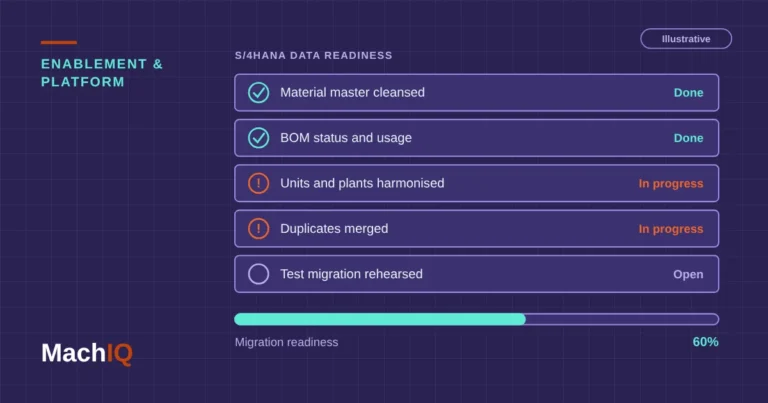
How ready are you?
Asset master     ≥ 90% of active machines with serial, site and as-built
Failure history  ≥ 80% of service orders with structured failure code
                 and replaced part numbers
Parts data       service parts classified, supersessions structured
Sensor data      signals mapped to serial and component, consistent timestamps

Predictive maintenance pilot: all four layers above threshold for one machine type
Labels matter more than algorithms
A model learns failures from labelled history. If half the service reports say “other”, the model learns noise. Fixing failure codes and parts on service orders is less exciting than a model, and far more useful.
Which use cases work with today’s data?
| Use case | Needs | Sensors? |
|---|---|---|
| AI parts search (text or photo) | Classified parts, images, supersessions | No |
| Parts identification by serial | As-built, service BOM | No |
| Failure-code suggestion for technicians | Clean failure history | No |
| Spare parts demand forecast | Installed base, consumption history | No |
| Predictive maintenance | All four layers, clean labels | Yes |
Where should you start?
- Pick one machine type with many units in the field and decent service history.
- Clean the asset master and link service orders to serial numbers.
- Introduce a short failure code list and capture replaced parts on every order.
- Start a no-sensor use case that shows value within months.
- Add sensor data for the components that fail most, once labels exist.
Checklist
- Active machines with serial, site and as-built
- Service orders linked to serial numbers
- Structured failure codes in use
- Replaced parts captured on service orders
- Sensor signals mapped to component and serial
FAQ
What data is needed for predictive maintenance?
An asset master with as-built per serial, a clean failure and service history with replaced parts, structured parts data, and sensor signals linked to machine and component.
Why do predictive maintenance pilots fail?
Often because the failure history is too poor to learn from: missing failure codes, service orders not linked to machines, and no record of which parts were replaced.
Which AI use cases work without sensor data?
AI-assisted parts search and identification, failure-code suggestions for technicians, and spare parts demand forecasting, all based on clean master and service data.
What is an asset master?
A record of each machine in the field with its serial number, configuration, as-built parts, location and owner. It anchors every other data layer.
Where should a machine builder start with AI?
With one machine type, a clean asset master and structured service history, plus a use case that delivers value without sensors. Predictive maintenance comes after.
How ready is your data for AI?
Send us machine and service data for one machine type under NDA. We’ll return a readiness score per data layer and the first use case that fits.