Parts leakage analysis: how much spend goes to dealers, copies and the grey market
Leakage is the part of your installed base’s spend that never reaches you. How to measure it by channel and part family, what counts as real leakage, and which levers bring volume back.
Not ready to talk yet? Take the 3-minute Aftermarket Revenue Check
TL;DR
- Leakage = expected parts demand − parts sold by you and your authorised channel. Dealer sales of your genuine parts aren’t leakage.
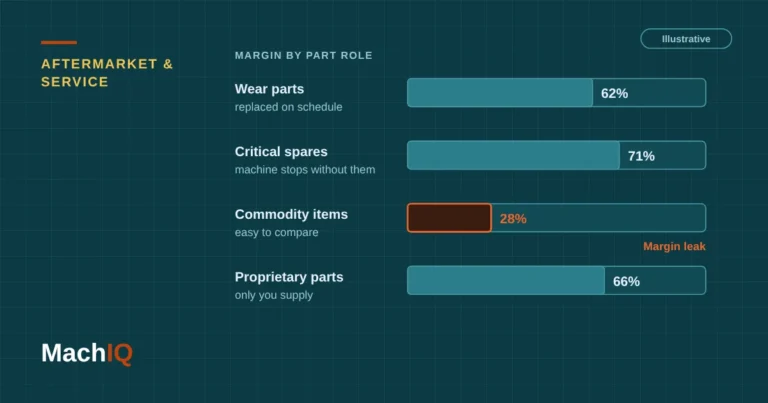
- Measure it per part family. Leakage concentrates in wear parts, consumables and standard components.
- Copy parts win on price and availability. Grey-market trade wins on price gaps between countries.
- Act where share is low and the gap is large: prices, kits, availability, dealer programmes.
What counts as leakage?
| Flow | Leakage? | Comment |
|---|---|---|
| OEM direct sales | No | Your own parts revenue |
| Authorised dealer sells your part | No | Captured, with dealer margin |
| Dealer sells a copy part | Yes | Often the largest hidden share |
| Customer buys from a copy maker or online | Yes | Commodity and wear parts |
| Grey market | Partly | Your part, but your regional price structure is bypassed |
| Customer makes the part in-house | Yes | Typical for simple machined parts |
How do you measure it?
Expected demand   per part family and region, from the aftermarket model
Captured          = OEM direct sales + authorised dealer sales of OEM parts
Leakage           = expected demand − captured
Leakage %         = leakage ÷ expected demand

Grey-market flag  = dealer purchases ÷ expected demand in the dealer’s territory
(well above 100% suggests resale outside the territory)Why does volume leak?
| Reason | Typical part families | Lever |
|---|---|---|
| Price gap | Filters, belts, seals | Market-level prices on commodity parts |
| Availability / lead time | Wear parts, standard electrical parts | Stock closer to customers, kits |
| Convenience | Anything bought in small quantities | Parts portal, consolidated orders |
| Dealer economics | All families sold through dealers | Dealer margins, targets, programmes |
| Unknown part number | Older machines | Better identification, cross-references, catalogue |
Don’t start with legal action
Copy parts are a symptom. If the price gap on a filter is 70%, customers will keep buying elsewhere. Fix price, availability and convenience first. Deal with IP issues for the parts where it really matters.
Where should you act first?
Checklist
- Expected demand per part family and region
- OEM and dealer sales of genuine parts
- Dealer territories and purchase volumes
- Price benchmarks for leaking families
- Cross-references to common copy parts
FAQ
What is parts leakage?
The share of your installed base’s spare parts demand that is bought from other sources, such as copy part makers, non-authorised dealers, online platforms or in-house manufacturing.
Are dealer sales leakage?
Not when an authorised dealer sells your genuine parts. Dealer sales of copy parts, however, are leakage and often a large hidden share.
What is grey-market parts trade?
Your genuine parts bought in a country with lower prices and resold in a country with higher prices, bypassing your regional price structure.
Which parts leak the most?
Typically filters, consumables, wear parts and standard components such as bearings and seals, where copies are easy to make and price gaps are large.
How can OEMs reduce parts leakage?
Match market prices on commodity parts, improve availability, offer kits, make ordering easy through a parts portal, and align dealer programmes so selling genuine parts pays off.
Where does your parts volume go?
Send us machine, parts and dealer sales data under NDA. We’ll show leakage by part family, region and channel.