Part standardisation across product families: fewer variants, better prices
Five machine families, eleven variants of the same proximity sensor. How to find standardisation candidates, agree preferred parts with engineering and qualify second sources without a redesign marathon.
Not ready to talk yet? Take the 3-minute Procurement Data Check
TL;DR
- Variants grow because every project picks its own parts. The cost shows up in purchasing, stock and service, not in engineering.
- Find candidates by attributes, not part numbers: same function, slightly different specs.
- Agree a preferred parts list per category with engineering and make it the default in CAD and PLM.
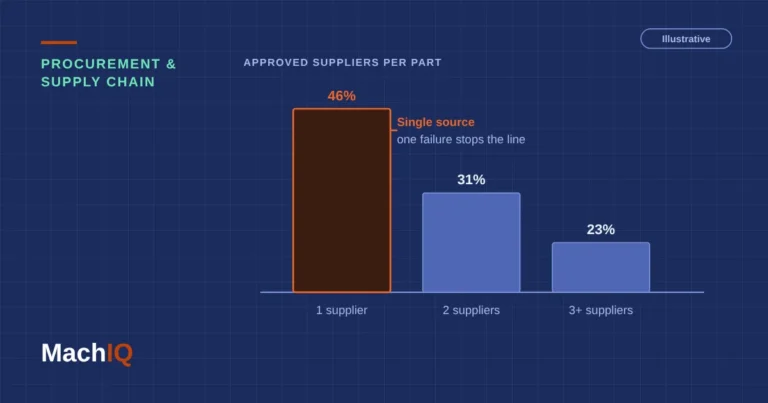
- Qualify a second source for every preferred part while you are at it. Standardisation and sourcing belong together.
Where do variants come from?
- Each project or plant chooses its own supplier and part.
- Engineers copy parts from the last machine, outdated ones included.
- Customer specifications force a brand or type.
- No preferred list is visible in CAD or PLM at design time.
| Cost of one more variant | Where it shows up |
|---|---|
| Smaller volume per part | Purchase price |
| Extra stock and safety stock | Working capital |
| Extra master data, drawings, approvals | Engineering and admin effort |
| More spare parts to stock and catalogue | Service |
| More supplier relationships | Procurement effort, risk |
How do you find candidates?
- Classify parts with attributes.
- Group by class and key attributes: same function, overlapping specs.
- Add volume, price and supplier per variant.
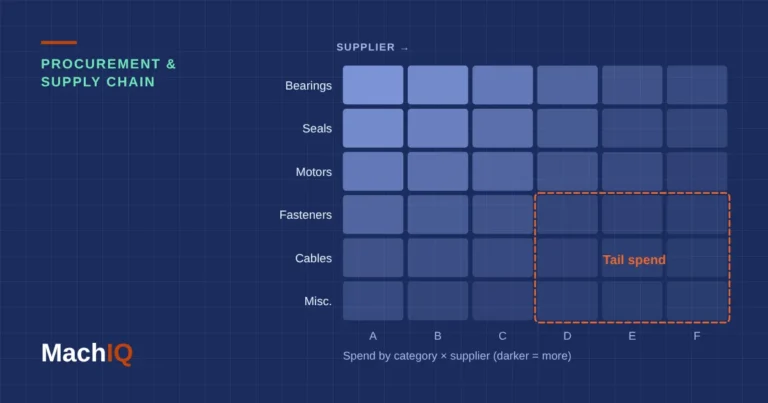
- Rank groups by spend × number of variants.
How do you agree the preferred part?
| Criterion | Question |
|---|---|
| Technical fit | Does it cover at least 90% of current applications? |
| Availability | Two qualified sources, acceptable lead times? |
| Total cost | Price + stock + admin, not just unit price |
| Lifecycle | Not close to end of life at the maker? |
| Service | Fits existing machines as a replacement? |
Don’t force a redesign of running machines
Standardise new designs and spare parts first. Changing machines already in production costs more than it saves, unless the part is being changed anyway.
How do you make it stick?
- Preferred parts appear first in the CAD library and PLM search.
- New non-preferred parts need an approval with a reason.
- Report variant counts per category to engineering management every quarter.
- Use supersession links so service moves to the preferred part as old variants run out.
Standardisation potential per group ≈
  Σ spend of non-preferred variants × expected price effect of bundling
+ stock reduction (fewer safety stocks)
+ admin saving (fewer part numbers × yearly cost per active part)

Rank groups by potential ÷ effort (drawings to change)
Checklist
- Parts classified with key attributes
- Spend and volume per variant
- An engineering owner per category
- Preferred list visible in CAD and PLM
- Approval rule for new non-preferred parts
FAQ
What is part standardisation?
Reducing the number of different parts used for the same function, usually by agreeing preferred parts per category and making them the default in new designs.
How do you find candidates for standardisation?
Classify parts with attributes, group them by function and key specifications, and rank the groups by spend and number of variants.
What is a preferred parts list?
A list of approved standard parts per category that engineers use by default. Non-preferred parts need a justified approval.
Does standardisation require redesigning existing machines?
Usually not. Start with new designs and spare parts. Change running machines only when the part is being changed anyway.
How does standardisation relate to alternate sourcing?
Closely. When you agree a preferred part, qualify a second source at the same time. Fewer variants make dual sourcing affordable.
How many variants do you buy for the same function?
Send us part master and purchasing data under NDA. We’ll return the top standardisation groups with spend and variant counts.