Make or buy for machine components: a cost model that includes the hidden costs
Most make-or-buy decisions compare a supplier price with internal variable cost, and get it wrong in both directions. A full cost model, the strategic criteria and a worked example.
Not ready to talk yet? Take the 3-minute Procurement Data Check
TL;DR
- Compare like with like: full internal cost vs. total cost of buying, not supplier price vs. machine hours.
- Free capacity changes the answer. Marginal cost only applies while capacity is really idle.
- Strategic criteria can override cost: core know-how, IP, quality risk, supply risk.
- Review make-or-buy per part family every two to three years. Volumes, rates and suppliers change.
What goes into the comparison?
| Make (internal) | Buy (external) |
|---|---|
| Material | Purchase price |
| Machine hours × machine rate | Freight, packaging, customs |
| Set-up and programming | Incoming inspection |
| Labour incl. indirect | Supplier management and audits |
| Tooling and fixtures | Inventory and safety stock |
| Quality cost (scrap, rework) | Quality cost (claims, sorting) |
| Overheads (space, energy, planning) | Risk premium (single source, lead time) |
A worked example
| Cost per part, lot size 50 | Make | Buy |
|---|---|---|
| Material / purchase price | $18.40 | $61.00 |
| Machining (0.42 h × $95) | $39.90 | – |
| Set-up (2.5 h × $95 ÷ 50) | $4.75 | – |
| Quality, scrap | $1.90 | $0.80 |
| Overhead allocation | $6.10 | – |
| Freight, inspection, admin | – | $4.20 |
| Inventory and risk | $1.20 | $3.10 |
| Total | $72.25 | $69.10 |
Buying wins by $3.15 at full cost. If the machine would otherwise stand idle, only material, energy and consumables are truly variable, and making wins clearly. That’s why capacity utilisation belongs in every make-or-buy decision.
Which strategic criteria override cost?
- Core competence: does this part carry your differentiating know-how?
- IP: would a supplier learn something you don’t want shared?
- Quality risk: tight tolerances, safety-critical function.
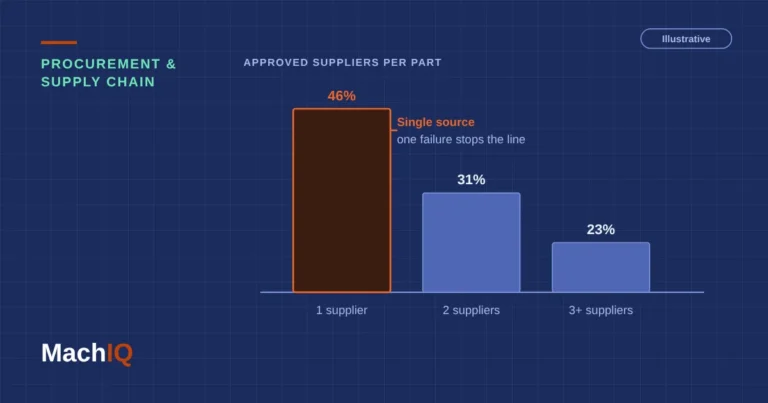
- Supply risk: few capable suppliers, long lead times.
- Flexibility: short-notice changes and many variants.
How do you run it across many parts?
Check the machine rate first
Machine rates are often calculated once and never updated. An outdated rate makes internal production look cheaper or more expensive than it is. Recalculate with current utilisation before you compare.
Checklist
- Current machine rates based on real utilisation
- Routings with realistic times per part family
- Supplier quotes including freight and terms
- Quality cost data for internal and external parts
- Strategic criteria agreed with management
FAQ
What is a make-or-buy analysis?
A comparison of the full cost and the strategic impact of producing a part internally versus buying it from a supplier.
Which costs are often missed in make-or-buy?
Set-up, overheads and quality cost on the make side; freight, incoming inspection, supplier management, inventory and risk on the buy side.
Should we use full cost or marginal cost?
Full cost for long-term decisions. Marginal cost only applies to short-term decisions while capacity would otherwise stand idle.
When should we make a part even if buying is cheaper?
When it carries core know-how or IP, is quality- or safety-critical, or when very few suppliers can deliver it reliably.
How often should make-or-buy decisions be reviewed?
Every two to three years per part family, or earlier when volumes, machine rates or supplier markets change significantly.
Which of your parts should you really make?
Send us routings, machine rates and purchasing data for one part family under NDA. We’ll return a make-or-buy comparison at full cost.